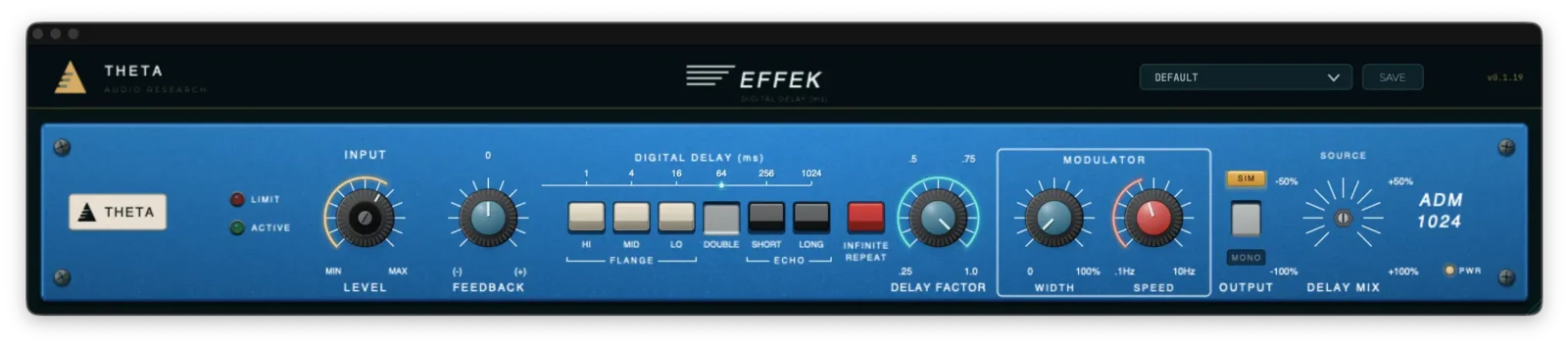
Are your delay throws sounding too harsh and clinical? Tired of clean digital echoes that clutter your headroom and fight with your lead vocal for center stage? Modern stock delays often lack that organic weight, forcing you to stack three different EQs and saturators just to make them sit in the pocket.
EFFEK solves this straight out of the gate by faithfully rebuilding a legendary 1983 blue-faced rack unit powered by real 1-bit adaptive delta modulation. It rounds off harsh transients naturally, giving your tracks that liquid, tape-like movement without the digital mud.
Why EFFEK is a Game-Changer for Your Mix & Workflow
- True 1-Bit Codec Warmth: Uses authentic slope overload so fast drum hits and bright vocal transients arrive softly rounded, giving you that instant vintage “analog” glue without extra processing.
- Continuous Tape-Style Glide: Powered by a shared VCO clock running across two octaves, delivering silky Doppler pitch sweeps with zero digital glitching or awkward interpolation artifacts.
- Secret Vintage Limiter Mode: Defeat the range buttons to run the codec at zero delay, unlocking a rare, gritty studio limiter preset that adds instant body and vibe to drums and vocals.
- Chaotic Granular Sound Design: Latch multiple range buttons at once to force the internal DRAM banks to fight for the bus, producing ghost grains, glitchy stutters, and unexpected ear candy.
- 1983 Pseudo-Stereo Spread: Keeps your low-end anchored dead center while spreading mids and highs across the stereo field for massive width that stays mono-compatible.
- Sound-on-Sound Looping: Freeze your bit RAM with the Infinite Repeat button while continuing to bend and modulate the frozen buffer live.
⚡ Pro Producer Tip: The Hidden 1983 Vocal Thickener
Engage the Double range with DELAY MIX set to ±50% and dial in just a touch of negative feedback with slow modulation width. Because the feedback re-encodes through the 1-bit codec on every single pass behind the 12 kHz loop filter, you get a buttery, dimensional doubling effect that thickens thin lead vocals without eating up precious headroom.
Tech Specs (Keep it Light)
- Platform: macOS (v0.1.16)
- File Size: 24.7 MB lightweight install
- Architecture: Real 1-bit Adaptive Delta Modulation (250 kHz – 1 MHz bit clock)
- Delay Span: 0.25 ms to 1024 ms across 6 switchable DRAM banks
- Controls: Bipolar Feedback, Bipolar Delay Mix, Sine LFO Modulator, Infinite Repeat
- Meters: Post-pot Active Lamp & authentic hardware Slope-Overload Limit detector
The Verdict
EFFEK is not just another sterile delay plugin – it is a full-blown character box that breathes organic texture into cold digital mixes. Whether you need liquid 80s chorus, sweeping tape flanges, or wild granular glitches from defeated memory interlocks, this tool delivers raw personality that slaps.


EFFEK_v0.1.19 MAC ( 25 MB )
📥 Want instant updates on new free VSTs? Join our Telegram Channel!
Let me know in the comments how this sits in your latest project! Have you taken the hidden broken-button limiter for a spin on your drum bus yet? Let’s talk shop below! 👇

We’re audio producers and sound designers with over 20 years of experience in the industry. Our team has lived through the entire evolution of digital audio production.
Our mission? To filter out the junk and bring you only the studio-ready free VSTs that actually compete with paid gear. We do the digging so you can focus on creating.