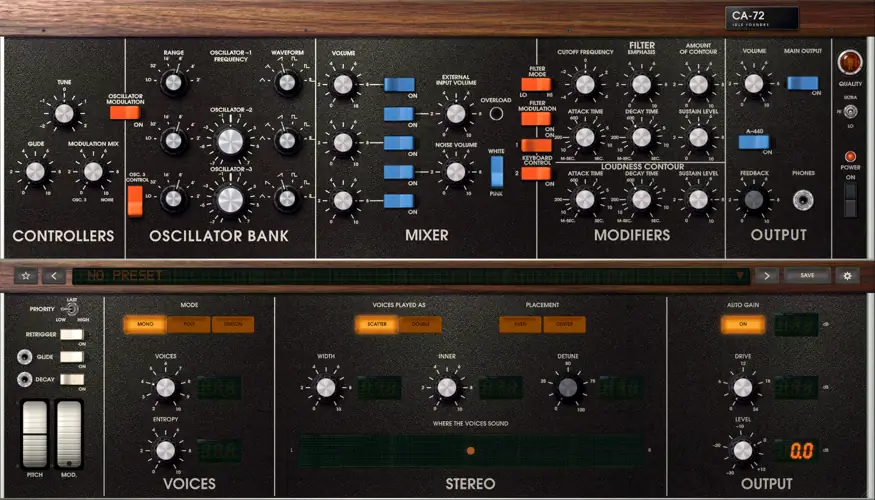
I’ve been digging through the web and found something special for your arsenal today.
Let’s keep it real: how many times have you dialed in a bass patch on a stock synth, only for it to sound completely stiff, sterile, and cold? In modern digital production, getting authentic low-end warmth is a constant uphill battle. You end up stacking three saturation plugins, an EQ, and a chorus just to make a simple bassline feel alive, only to destroy your headroom and end up with a muddy low-mid mess.
Most soft synths sound too mathematically perfect – they lack the electrical quirks, component drift, and raw bite that made vintage hardware slap so hard on classic records.
Idle Foundry just solved that headache for good with the CA-72.
Why CA-72 is a Game-Changer for Your Mix & Workflow
The CA-72 is not just another lazy sample-based synth or generic digital subtractive synth skin. The developer literally broke down the original 1972 – 73 Minimoog Model D service manuals, transcribed the legendary “early” CA3046 oscillator boards into SPICE netlists, and built this engine from deep circuit simulations.
Here is what that level of detail actually does for your workflow:
- Authentic 1972 Circuit Drift: You get natural phase fluctuations and warm analog drift without touching a chorus or unison knob, making your basslines feel alive and moving.
- Effortless Mix Placement: Because the ladder filter is simulated at the component level, the low end sits in the mix naturally right under your kick, freeing up valuable mix headroom.
- True Polyphony Option: While the original hardware was strictly monophonic, the CA-72 lets you flick into full polyphonic mode – giving you a complete simulated Minimoog engine per note for thick, lush retro chords.
- Harmonic Richness Out of the Box: The oscillators push natural, non-linear harmonic saturation that cuts straight through mobile speakers without needing extra distortion.
- Multi-Platform Freedom: With support for CLAP, VST3, and AU across Windows, Mac, and Linux, it drops into any modern DAW session seamlessly.
⚡ Pro Producer Tip: Push the Filter Input for Free Glue
Don’t slap an aggressive clipper on your channel right away. Instead, crank the oscillator mixer levels directly inside CA-72 into the modeled filter circuit. The component simulation saturates naturally like real analog hardware, shaving off harsh transient spikes while adding musical third harmonics that make your sub bass cut cleanly through dense mixes.
Tech Specs (Keep it Light)
- Formats: VST3, CLAP, Audio Unit (AU)
- Platforms: macOS, Windows, Linux
- Download Size: 133 MB
- Architecture: Component-level SPICE simulation (CA3046 oscillator board)
- Voicing: Monophonic & Multi-Voice Polyphonic modes
- Price: 100% Free / Open Source
The Verdict
If you produce hip-hop, funk, synthwave, or indie pop, having a reliable Model D emulation in your toolkit is mandatory. Most free alternatives either sound thin or eat up your CPU like crazy, but CA-72 hits that sweet spot. It slaps with deep, chest-thumping weight, delivers that iconic creamy filter resonance, and captures the unmistakable vibe of early ’70s analog circuitry without costing a dime.
Grab this one immediately, drop it on your next bass track, and hear the difference real circuit modeling makes.


CA-72.0.2.4 ( 133 MB )
📥 Want instant updates on new free VSTs? Join our Telegram Channel!
Let me know in the comments how this sits in your latest project! Are you running this for raw sub basslines or flipping it into poly mode for vintage chords? Let’s talk shop below! 👇

We’re audio producers and sound designers with over 20 years of experience in the industry. Our team has lived through the entire evolution of digital audio production.
Our mission? To filter out the junk and bring you only the studio-ready free VSTs that actually compete with paid gear. We do the digging so you can focus on creating.