Lisp v1.0

Lisp
size 0.75 MB / 0.80 MB
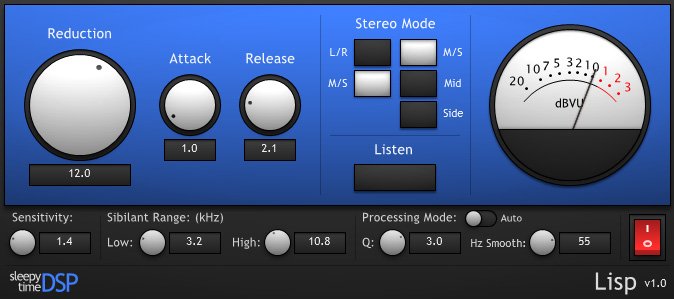
Lisp is a level-independent sibilance processor.
Whether you use a traditional de-esser, sidechained compressor, dynamic EQ, or even edit your tracks manually, cleaning up sibilance problems in your vocals can get pretty tedious. Lisp is new type of de-esser that aims to speed-up this process with its automatic sibilance detection algorithm.
Internally tuned to the human vocal range, Lisp can automatically detect and lower annoying “ss”, “teh”, and “ch” sounds in your audio by tracking both the amplitude and pitch of its input in real-time. Just set the reduction amount and let Lisp do the rest!
Lisp’s internal algorithm doesn’t rely on traditional threshold/frequency-based techniques found in most current de-essing systems. Instead, it uses a modified form of the Sleepy-Time Records transient detection algorithm (previously found in the KVR-DC2012 entry: Transient) coupled with fast frequency detection and phase-cancellation methods to remove unwanted sibilance, regardless of the input level. The result is a very natural and pleasing vocal with harsh “s” sounds under control no matter what distance the singer is in relation to the microphone. Not only that, but the entire process is highly CPU efficient, allowing you to use more instances in your project.


STDSP_Lisp ( 0.75 MB )
STDSP_Lisp_x64 ( 0.80 MB )

We’re audio producers and sound designers with over 20 years of experience in the industry. Our team has lived through the entire evolution of digital audio production.
Our mission? To filter out the junk and bring you only the studio-ready free VSTs that actually compete with paid gear. We do the digging so you can focus on creating.
Recent Posts
EFFEK – Vintage ADM Delay
Are your delay throws sounding too harsh and clinical? Tired of clean digital echoes that clutter your headroom and fight…
Noise Canvas – Spectral Painter
I just stumbled upon this gem today, and it completely flipped my sound design workflow upside down. We have all…
Reflexive EQ – Dynamic EQ
Tired of harsh resonances eating up your headroom every time your vocalist belts or your snare smacks? We've all been…
NAM JUCE – Free Amp Modeler
Tired of thin, plastic-sounding digital guitar tones that completely vanish the second you start stacking drums and bass? We have…
The Bass Particle – Sub Resonator
Tired of your 808s and kick drums sounding paper-thin, but every time you push the low-end EQ, your whole mix…
Box of Bass – Bass Rig Plugin
Are your DI bass tracks sounding sterile, flat, and completely disconnected from the rest of your track? We have all…