Audio Damage – Ronin

Ronin
size 2 MB / 2.5 MB
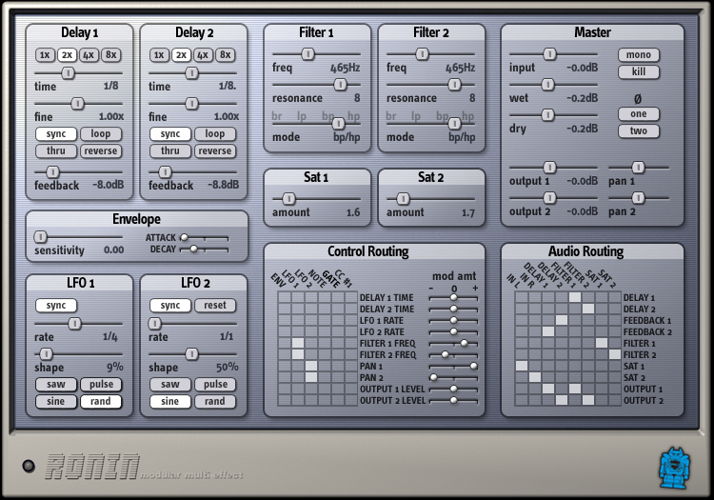
Ronin is a multi-effects plug-in featuring two delays, two multi-mode filters, two tube saturation stages, and two LFOs, with a fully routable signal path, is a total solution for analog-style effects.
With “bucket-brigade” modeled delays, Ronin is capable of tape-style delays, true analog chorus effects, and flanging in to the stratosphere, for everything from basic subtle synced delays to complete audio destruction.
Delay Modules: Modeled after traditional analog bucket-brigade style delays, the delays in Ronin pitch the signal when the time is changed, enabling pitch bombs, chorus effects, pitch-bend flanging, or tape-style delays with time flutter. Both delay modules have sync to host, infinite loop, and reverse modes, as well as positive (more than 50%) feedback for overloaded feedback effects.
Filter Modules: Ronin’s filter modules are multi-mode filters with notch, lowpass, bandpass, and highpass outputs continuously variable, and are capable of self-oscillating, for creating synth effects in high resonance situations.
LFOs: The pair of low frequency oscillators in Ronin have four shapes: sine, sawtooth, pulse, and random. The shape control continuously varies the waveform. The LFO rate is a mod destination, so the LFO can mod itself, for very extreme waveform shapes. Both LFOs can be synced to MIDI host, and the second LFO’s waveform can be reset by the first LFO.
Saturation Modules: Ronin features a pair of “tube” saturation stages, for everything from subtle smoothing to extreme tube-style distortion.
Routing Matrix: The matrices in Ronin enable full control over the signal path. Both audio and control can be routed as the user desires. In the case of audio, extreme patches are possible; nothing is forbidden. Want to route the filters back in on themselves? No problem. Want to insert distortion and resonance in the feedback loop of the delays? Help yourself. Ronin puts the routing in your hands.
MIDI Learn: Every control on the Ronin UI can be controlled via external MIDI devices. A simple key-click combination puts the UI element in learn mode; twist the knob on your controller and you’re done. Another combination removes it. Simple as that.
MIDI as mod routing: MIDI note, mod wheel, and gate can be used as mod sources, in addition to the MIDI learn mode. These are available as patch points in the routing matrix.
Envelope Follower: Another mod source is the envelope section, which creates control signals from the input level of the plug-in, with separate sensitivity, attack, and decay controls.


Audio_Damage_Ronin_Win ( 2 MB )
Audio_Damage_Ronin_Mac ( 2.5 MB )

We’re audio producers and sound designers with over 20 years of experience in the industry. Our team has lived through the entire evolution of digital audio production.
Our mission? To filter out the junk and bring you only the studio-ready free VSTs that actually compete with paid gear. We do the digging so you can focus on creating.
Recent Posts
Relic – 13 Analog Plugins
Tired of your in-the-box mixes sounding flat, sterile, and cold? We have all been there - you stack clean digital…
StereoiXer – Spatial Processor
Are your mixes sounding flat, boxed-in, and totally lifeless? I found a fix. We have all been there in the…
StemDeck – AI Stem Splitter
We've all been there: you stumble across an absolute grail of a sample, but the kick is clashing hard with…
DiodeCrush – Crush Compressor
Are your drums sounding a little too polite and thin? We've all hit that wall where standard digital compressors keep…
Focus – Stereo Bus Utility
Tired of your mix sounding wide in your headphones, but the second you test it in the car or on…
The Usual Suspects – Plugin Manager
What's good fam! Nothing kills the studio vibe faster than sitting down to cook up, opening your DAW, and realizing…